
The Tanuki at the Edge of Town
By Gina Keatley
At the far edge of Akō, where the town thins out and daily life loosens its grip, there is a secondhand store that feels less like retail and more like an archive in flux. Cycle Hit Ako sits quietly off the main rhythm of the city, its shelves crowded with objects that have already lived full lives elsewhere. Furniture bears the softened edges of use. Ceramics hold the weight of hands that once chose them for reasons now forgotten. Nothing here feels curated in the contemporary sense, yet everything is charged with intention.
This is where I found him.
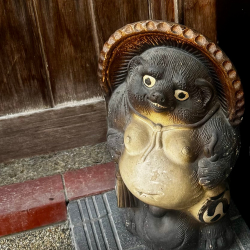
The ceramic tanuki stood among mismatched items, neither highlighted nor hidden. His surface was worn but intact, his posture confident, his expression unreadable in the way folk objects often are. He carries the familiar iconography passed down through generations: round belly, wide eyes, a form that blurs humor and symbolism. In Japanese tradition, the tanuki is a shapeshifter, a trickster, a guardian of thresholds. He is associated with prosperity, mischief, adaptability, and survival — qualities that feel less symbolic when you encounter them quietly, outside a shop at the edge of town.
As an American artist in Akō, I’m constantly aware of my position between worlds. Objects like this tanuki make that in-between state visible. He is not precious, not rare, not preserved behind glass. He is meant to live outdoors, to weather seasons, to mark a boundary between inside and out. In many ways, he mirrors my own role here — present, observing, absorbing, slowly being shaped by time and place.
Cycle Hit Ako specializes in the overlooked. Vintage furniture, discarded artworks, practical things once valued and then set aside. The store delivers, extending the lives of these objects further into the present. That act alone feels quietly radical. In a culture where newness often signals progress, this space insists that continuity matters — that reuse is not just economical, but philosophical.
Placing the tanuki outside the creative headquarters in Akō felt instinctive. He now stands as a kind of informal sentinel, greeting visitors without explanation. He doesn’t instruct or announce. He simply occupies space, carrying with him layered histories I may never fully know. That unknowability is part of the work. As an artist, I’m drawn to materials that hold memory without narrative clarity. Objects that resist a single interpretation, yet remain undeniably present.
In my practice, I think often about thresholds — between cultures, materials, identities, and geographies. The tanuki belongs to that category. He is humorous and serious, traditional and contemporary, ordinary and symbolic. He exists not to be decoded, but to be lived alongside.
At the edge of town, at the edge of understanding, he stands. And somehow, that feels exactly right.
町はずれのタヌキ
ジーナ・キートリー
赤穂の町が静かにほどけ、日常の輪郭が少しずつ薄れていくその先に、ひとつのリサイクルショップがある。そこは単なる店舗というより、流動するアーカイブのように感じられる場所だ。サイクルヒット赤穂店は、街の主旋律から少し外れた場所にひっそりと佇み、棚にはすでに別の人生を生きてきた物たちが所狭しと並んでいる。家具には使い込まれた角の丸みがあり、陶器には、かつて何かの理由で選ばれた手の記憶が静かに残っている。その理由はもう失われているかもしれない。現代的な意味での「キュレーション」は感じられないが、そこにあるすべての物が、不思議なほどの意志を帯びている。
ここで、私は彼に出会った。
陶製のタヌキは、ちぐはぐな品々の中に立っていた。特別に目立たされることも、隠されることもなく。表面には時の痕跡が刻まれているが、形はしっかりと保たれ、姿勢にはどこか自信がある。民藝のオブジェによく見られる、読み取れそうで読み取れない表情をしている。丸い腹、大きな目。ユーモアと象徴の境界を曖昧にするその姿は、世代を超えて受け継がれてきたイメージそのものだ。日本の伝統において、タヌキは変化する存在であり、トリックスターであり、境界を守る者でもある。繁栄、いたずら心、適応力、生き延びる力。町はずれの店先で静かにそれと向き合うと、それらの意味は単なる象徴ではなく、現実味を帯びて感じられる。
赤穂で活動するアメリカ人アーティストとして、私は常に「間」にいる感覚を意識している。このタヌキのような存在は、その中間的な状態を可視化してくれる。彼は貴重品ではなく、希少でもなく、ガラスケースに守られる存在でもない。屋外で風雨にさらされ、季節を受け止め、内と外の境界を示すために生きている。その在り方は、多くの意味で、今の私自身の立場と重なっている。ここに存在し、観察し、受け取り、時間と場所によって少しずつ形作られていく。
サイクルヒット赤穂店が扱うのは、見過ごされがちな物たちだ。ヴィンテージ家具、手放されたアート作品、かつては価値を持ち、やがて脇に置かれた実用品。配送も行い、それらの物の寿命を現在へと延ばしている。その行為自体が、静かに、しかし確かなラディカルさを持っている。新しさが進歩の指標とされがちな文化の中で、この場所は「連続性こそが重要だ」と語っている。再利用は経済的な選択であるだけでなく、哲学的な姿勢でもあるのだ。
このタヌキを赤穂のクリエイティブ・ヘッドクォーターの外に置くことは、ごく自然な判断だった。今、彼は説明もなく訪れる人を迎える、非公式な番人のように立っている。何かを指示することも、主張することもない。ただそこに在り、自分でも完全には知り得ない重層的な歴史を抱えている。その「わからなさ」こそが、この作品の一部だ。私は、明確な物語を持たず、それでも記憶を宿す素材に強く惹かれる。ひとつの解釈に収まらず、しかし確かに存在しているもの。
私の制作において、境界という概念は常に重要なテーマだ。文化と文化の間、素材と素材の間、アイデンティティと地理の間。タヌキは、まさにその領域に属している。ユーモラスでありながら真剣で、伝統的でありながら現代的。ありふれていながら象徴的。彼は解読されるために存在するのではなく、共に生きられるためにそこにいる。
町の端で、理解の端で、彼は立っている。
そして不思議なことに、それはとても正しい位置に思える。